
Gemini Omni — what Google’s video model does, what it costs and how to run it
Updated 22 September 2026 · Twin AI Labs
Gemini Omni is Google’s video model: it turns text, images and reference clips into video and synthesises the audio in the same pass as the picture. The 1.1 Flash update landed on August 27, 2026 with 3–10 second clips at 24 frames per second and scene extension in 10-second steps up to 40. Twin AI has carried the model since September 11, 2026 at 600 credits per clip.

What Gemini Omni is
Gemini Omni is Google’s family of generative models that starts with video: it takes text, images, audio and short video clips and returns a finished clip. Google showed it at I/O in May 2026, opened it to developers on June 30 through the Gemini API, AI Studio and the Agent Platform, and shipped the Gemini Omni 1.1 Flash update on August 27, 2026 under the model id gemini-omni-1.1-flash.
What separates it from the earlier Veo generation is not frame quality but the way you work. Clips are edited by conversation: you write “remove the car on the left” or “make it evening instead of morning”, and the model rebuilds the scene while holding the character and the physics steady between takes. The context window is 1,048,576 tokens, so a long scene description and its references fit into a single request.
What Gemini Omni 1.1 Flash can do: 4K, 40 seconds and audio
The model covers five tasks: generate from text, from an image, from a reference, edit an existing clip and extend a scene. Inputs accept up to 10 images and up to 3 video clips of no more than 3 seconds each.
A base clip runs 3 to 10 seconds at 24 frames per second. From there a scene extends in 10-second steps until it reaches a 40-second total. One detail Google does not put in the headline: only 360p and 720p render natively, while 1080p and 4K are upscales of that same render. Audio — dialogue, sound effects and ambience — is synthesised in the same pass, so no separate voice-over step is needed. Every output file carries an invisible SynthID watermark that can be detected programmatically.

| Parameter | Value |
|---|---|
| Clip length | 3–10 seconds, extended in 10 s steps to 40 s |
| Frame rate | 24 frames per second |
| Resolution | 360p and 720p native; 1080p and 4K upscaled |
| Aspect ratio | 16:9 and 9:16 |
| Audio | Dialogue, effects and ambience in the same pass |
| Inputs | Up to 10 images and 3 clips of up to 3 s |
| Labelling | Invisible SynthID watermark on every file |
What Gemini Omni costs
The Gemini API bills tokens across three meters at once: about $1.50 per million input tokens, $9.00 per million text output tokens and $17.50 per million video output tokens. Google itself converts that into the number people can act on — an effective price per second of finished video.
In practice a ten-second 720p clip lands near a dollar, and the same clip in 4K near three. Consumer access works differently: inside the Gemini app the model comes with the paid Google AI Plus, Pro and Ultra tiers and daily caps on how many clips you get, while YouTube Shorts and YouTube Create received part of the feature set for free.
| Resolution | Per second | Ten seconds |
|---|---|---|
| 360p | ≈ $0.03 | ≈ $0.30 |
| 720p | ≈ $0.10 | ≈ $1.00 |
| 1080p | ≈ $0.15 | ≈ $1.50 |
| 4K | ≈ $0.30 | ≈ $3.00 |
Where Gemini Omni is hard to reach
Access to the model depends on access to Gemini itself, and that is uneven. Russian users, for one, report that on August 14, 2026 the service stopped answering even through a VPN, returning “Error 1060” or the standard notice that Gemini is not yet supported in their country. Google published no statement about a full block, so the accurate description is “stopped opening”, not “shut down”.
The practical consequence is the same everywhere the Gemini app is unavailable or the paid tier cannot be billed to a local card: you cannot build a clip on Gemini Omni directly. What remains is foreign infrastructure with a foreign card, or a service that has already wired the model in.
How to generate a Gemini Omni clip without a Google plan
The short path is to open the model inside Twin AI: generation runs on our side, so there is no VPN and no Google account involved. The order of work:
- Open video generation and pick Gemini Omni from the model list — it sits second in our text-to-video ranking.
- Upload a photo if you are animating a still: the model takes up to two anchor images, the first and the last frame of the scene.
- Describe the scene in words: what is in frame, how the camera moves, what you hear. The prompt field accepts up to 5,000 characters.
- Choose duration (4, 6, 8 or 10 seconds), resolution (360p, 720p, 1080p or 4K) and the 16:9 or 9:16 orientation.
- Run it and collect the file: across our logs for the past 30 days the median wait for a clip is 99 seconds.
Gemini Omni inside Twin AI: parameters and credit price
The model entered our catalogue on September 11, 2026 and runs in two modes — from text and from an image. The base price is 600 credits for a 4-second 720p clip; longer and heavier settings add a fixed surcharge, while 360p, 720p and 1080p all cost the same.
Credits convert as follows: a 1,000-credit pack is 990 ₽, 3,000 is 2,490 ₽ and 8,000 is 5,490 ₽; plans run 1,290 ₽ for 2,500 credits a month, 2,490 ₽ for 5,000 and 4,490 ₽ for 15,000.


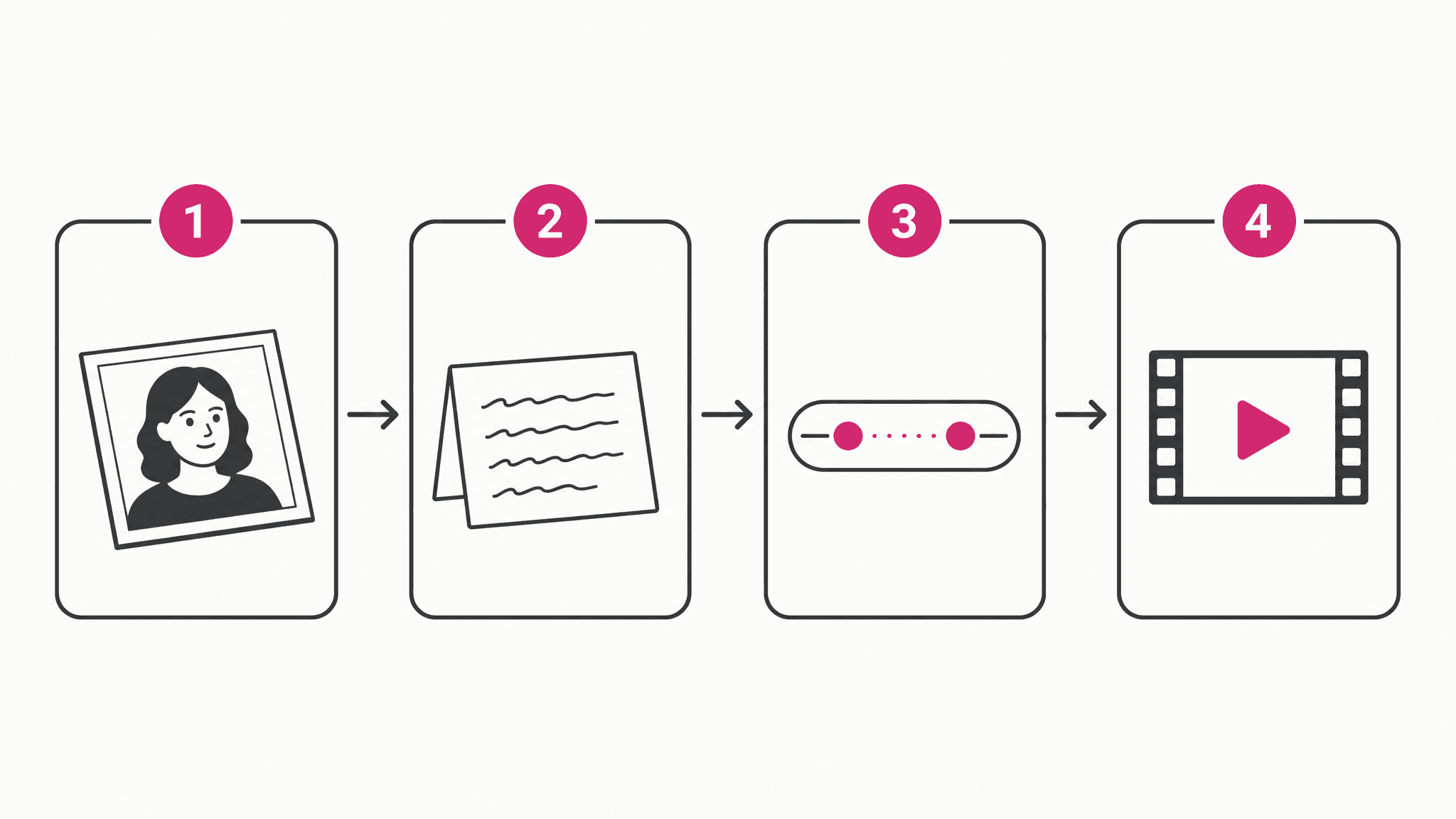
An ordinary phone photo and a frame of the clip built out of it
| Setting | Surcharge | Total per clip |
|---|---|---|
| 4 seconds, 720p (base) | — | 600 credits |
| 6 seconds | +80 | 680 credits |
| 8 seconds | +160 | 760 credits |
| 10 seconds | +240 | 840 credits |
| 4K instead of 720p | +320 | 920 credits for 4 s |
| 360p, 720p, 1080p | 0 | 600 credits |
Gemini Omni versus Wan 3.0, Seedance and Veo 3.1
By the Artificial Analysis tables in September 2026, Gemini Omni Flash leads the video models that ship audio: Elo 1233 against 1229 for Wan 3.0 and 1227 for MiniMax H3 Max. A gap of a few points is not the difference between good and bad — it is the difference between first and third place in a table that is rebuilt every week.
Our own catalogue ranks them almost the same way, with one swap at the top: Wan 3.0 at 1242, Gemini Omni at 1237, MiniMax H3 at 1225, Seedance 2.0 at 1220, then Kling 3.0 (1108) and Veo 3.1 (1088). One detail matters for the bill: Veo 3.1 is also Google, yet it costs 900 credits against 600 for Gemini Omni and sits lower in the ranking.
| Model | Twin Elo | Price per clip |
|---|---|---|
| Wan 3.0 | 1242 | 600 credits |
| Gemini Omni | 1237 | 600 credits |
| MiniMax H3 | 1225 | 600 credits |
| Seedance 2.0 | 1220 | 600 credits |
| Kling 3.0 | 1108 | 600 credits |
| Veo 3.1 | 1088 | 900 credits |
Which model to pick for which job
A short cheat sheet once you know what you need. Over the past 30 days 279 clips went through our video generation, and 226 of them — 81% — started from an uploaded photo rather than from pure text. The typical job here is animating a still.
- A clip with audio in one pass, plus conversational scene edits → Gemini Omni: that is its strength.
- Top of the text-to-video ranking → Wan 3.0, first row of the catalogue.
- Complex motion, physics and a longer scene → Seedance 2.0 or Seedance 2.5.
- Cinematic camera work and the familiar Google pipeline → Veo 3.1, at 900 credits per clip.
- Video from a photograph → any model with an image-to-video mode; that is 81% of everything we generate.
- No idea which one wins on your prompt → Compare mode sends one prompt to several models at once.
Honestly: what Gemini Omni and we do not do
Three limits worth knowing up front. First, 1080p and 4K are upscales of a native 360p or 720p render, so fine texture will not appear out of nowhere at four times the resolution. Second, SynthID stays in the file permanently — a deliberate Google decision that marks the clip as generated.
The third one is on us. Twin AI wires up text-to-video and image-to-video with fixed lengths of 4, 6, 8 and 10 seconds. Conversational editing of a finished clip and scene extension to 40 seconds are not available here — those modes live only in Google’s own interfaces. If that is exactly what your job needs, the honest answer is that you need Gemini itself, not an intermediary.
Sources
- Google — Introducing Gemini Omni: availability and capabilitiesblog.google
- Google AI for Developers — gemini-omni-1.1-flash model card: clip length, 24 fps, resolutionsai.google.dev
- Google DeepMind — Gemini Omni Flash model carddeepmind.google
- Artificial Analysis — text-to-video model leaderboardartificialanalysis.ai
FAQ
What is Gemini Omni?
It is Google’s family of generative models that began with video. The model accepts text, images, audio and short video clips and returns a finished clip with sound. The Gemini Omni 1.1 Flash release landed on August 27, 2026 under the model id gemini-omni-1.1-flash.
How long can a Gemini Omni video be?
A base generation runs 3 to 10 seconds at 24 frames per second. A scene can then be extended in 10-second steps until it reaches 40 seconds in total. Twin AI offers fixed lengths of 4, 6, 8 and 10 seconds and does not expose the extension mode.
What does Gemini Omni cost?
The Gemini API bills roughly $1.50 per million input tokens, $9.00 per million text output tokens and $17.50 per million video output tokens, which Google restates as about $0.03 per second at 360p, $0.10 at 720p, $0.15 at 1080p and $0.30 at 4K. In Twin AI a 4-second 720p clip is 600 credits, a ten-second clip is 840, and 4K adds 320 credits.
Does Gemini Omni generate audio?
Yes, and it is one of its defining traits. Dialogue, sound effects and background ambience are synthesised in the same pass as the picture, so no separate voice-over stage is needed. In the Artificial Analysis tables for September 2026, Gemini Omni Flash holds first place among models that ship audio at Elo 1233.
Is Gemini Omni available everywhere?
No. It follows the availability of Gemini itself, which is unavailable in a number of countries. Russian users report that since August 14, 2026 the service has failed to answer even through a VPN, returning “Error 1060” or an unsupported-country notice; Google has not published a statement about a full block. Twin AI has carried the model since September 11, 2026 and generates on its own infrastructure.
Gemini Omni or Veo 3.1?
Both are Google models, but in our ranking as of September 22, 2026 Gemini Omni sits well above: Twin Elo 1237 against 1088 for Veo 3.1. Price favours Omni too — 600 credits per clip against 900. Veo 3.1 is worth keeping if you are used to its framing and to the Flow pipeline.
How can you tell a clip came from Gemini Omni?
Google embeds an invisible SynthID watermark into every output file. It is not visible to the eye but can be detected programmatically, it cannot be removed with standard tools, and it applies to every clip the model produces, including those generated through third-party services.