
Diffusion Model — Definition, How It Works & Examples
Updated 30 July 2026 · Twin AI Labs
A diffusion model is a type of generative AI that creates images, video or audio by learning to reverse a noising process: during training it repeatedly adds random noise to real data, then learns to remove that noise step by step. To generate something new it starts from pure noise and denoises it into a clean result. Diffusion is the technology behind Stable Diffusion, DALL·E, Midjourney, FLUX and most 2026 image and video generators.

What is a diffusion model?
A diffusion model is a generative machine-learning model that turns random noise into structured data such as an image. The name comes from physics: the idea, introduced by Sohl-Dickstein and colleagues in a 2015 paper on non-equilibrium thermodynamics, mimics how particles diffuse and spread out over time. In AI, the model learns the exact opposite — how to run that diffusion backwards, pulling a coherent picture out of a field of static. Modern text-to-image tools are diffusion models conditioned on a text prompt, so the denoising is steered toward whatever you describe.
How a diffusion model works: forward and reverse
Every diffusion model has two processes. The forward process is a fixed recipe that takes a real training image and adds a little Gaussian noise over many steps until nothing but static remains. The reverse process is the part the network actually learns: at each step it predicts the noise that was added and subtracts it, so the image gradually comes into focus. The breakthrough that made this practical was the 2020 DDPM paper (Denoising Diffusion Probabilistic Models), which showed the reverse process could be trained stably and produce photorealistic results.
See the foundational 2015 paper at arxiv.org/abs/1503.03585 and the 2020 DDPM paper at arxiv.org/abs/2006.11239.
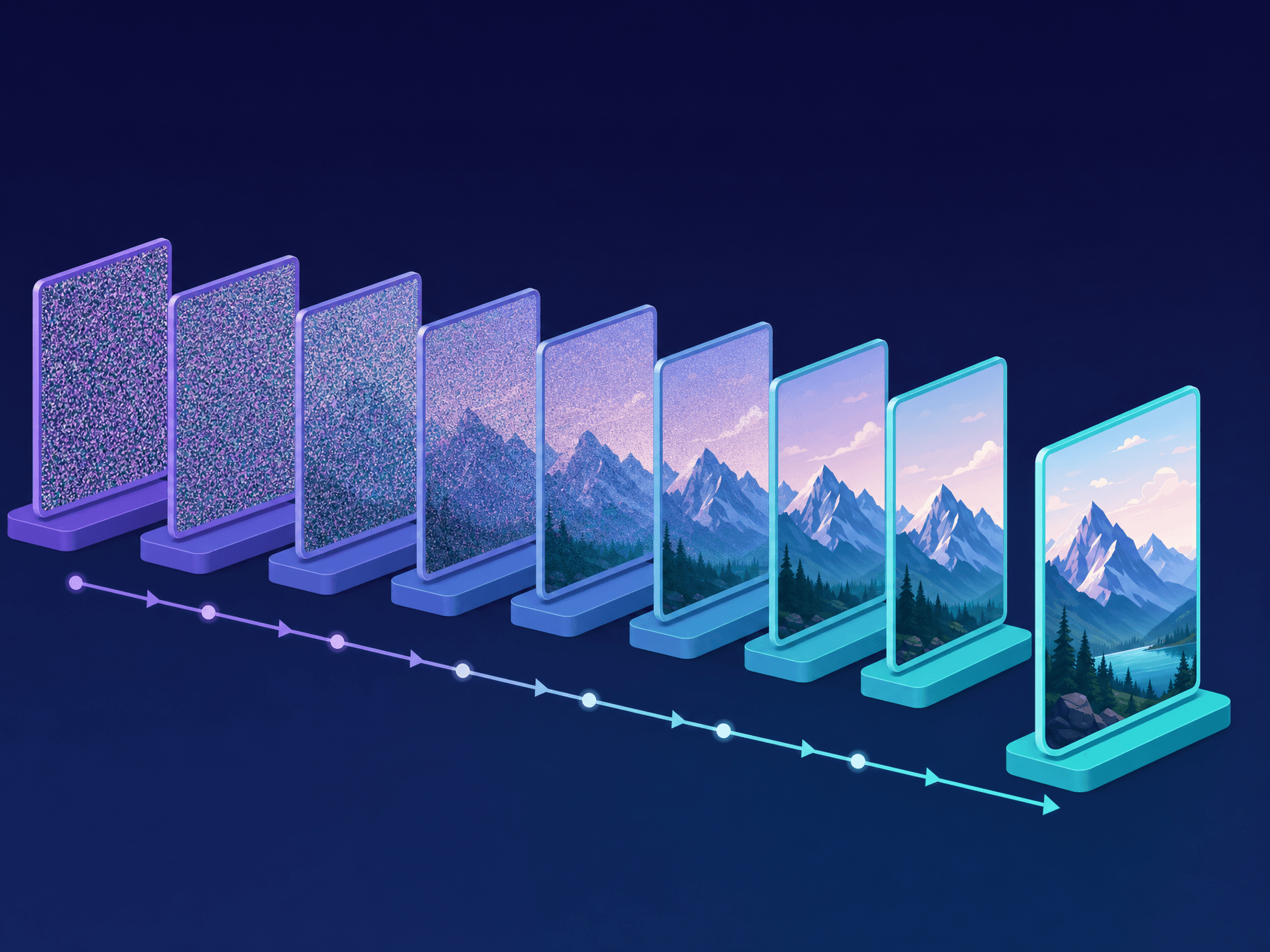
Latent diffusion: why it got fast enough for everyone
Early diffusion models denoised in full pixel space, which was slow and memory-hungry. The 2022 latent-diffusion paper — the basis of Stable Diffusion — moved the whole process into a compressed latent space using an autoencoder, cutting the compute cost by roughly an order of magnitude. That single change is why consumer text-to-image generation exploded in 2022 and 2023. A few numbers make the trade-offs concrete:
- Sampling steps: early models needed ~1000 denoising steps; modern samplers (DPM++, distillation) produce good images in 4–30 steps.
- Latent space: Stable Diffusion works on a 64×64 latent instead of a 512×512 image — about 48× fewer values to process per step.
- Guidance scale (CFG): a knob, typically 3–12, that controls how strictly the model follows your text prompt versus staying natural.
- Diffusion also powers video: 2026 models like Sora, Veo and Kling use diffusion transformers to denoise sequences of frames.
Diffusion vs GANs and other approaches
Before diffusion, GANs (generative adversarial networks) were the dominant way to generate images. GANs are fast at inference but notoriously unstable to train and prone to "mode collapse", where they produce limited variety. Diffusion models train stably, cover the full diversity of the data, and scale cleanly to huge datasets — which is why almost every state-of-the-art image and video generator switched to diffusion. The trade-off is that diffusion needs multiple denoising steps per image, so a lot of 2026 research focuses on step-distillation to make it as fast as a GAN while keeping the quality.
How Twin AI uses diffusion models
Twin AI is built on top of diffusion models — you use them every time you generate. When you open /create/photo or pick a template in /photoshoots, your prompt is sent to a diffusion model that denoises your image into existence. Twin runs several leading diffusion engines side by side, including /alternatives/stable-diffusion, /alternatives/flux-2-pro and Nano Banana, so you can compare outputs in /compare/midjourney-vs-flux without juggling separate accounts. Twin also trains a personal /glossary/lora-style adapter of your face so those diffusion models can place a consistent you into any scene. Everything is payable with a Russian card or SBP, with no VPN required. Start free in /create/photo.
FAQ
What is a diffusion model in simple terms?
A diffusion model is an AI that learns to turn random noise into a clear image. During training it repeatedly adds noise to real pictures and learns to reverse the process; to create something new it starts from pure noise and denoises it into a finished image guided by your text prompt.
Which AI tools use diffusion models?
Almost all of the popular 2026 image and video generators are diffusion models, including Stable Diffusion, DALL·E, Midjourney, FLUX, Ideogram, and video tools like Sora, Veo and Kling. Twin AI runs several diffusion engines in one place — GPT Image 2.5, Seedream, Nano Banana, Veo 3.1 and Kling 3.0 — though not Stable Diffusion, DALL·E, Midjourney, Ideogram or Sora.
What is the difference between a diffusion model and a GAN?
A GAN generates an image in a single pass using two competing networks, which is fast but unstable to train and less diverse. A diffusion model generates by gradually denoising over several steps — it is slower per image but trains stably and produces far more varied, higher-quality results, which is why it replaced GANs for most generation tasks.
Why are diffusion models slower than other generators?
A diffusion model refines an image over many denoising steps rather than in one shot, so it does more computation per image. Modern samplers and step-distillation have cut this from around 1000 steps to as few as 4–30, making generation feel near-instant in tools like Twin AI.
Do I need to understand diffusion to use Twin AI?
No. Diffusion is what runs under the hood — you just type a prompt or pick a template and Twin AI handles the model, sampler and steps for you. Try it free in /create/photo.