
Transformer — Definition, How It Works & Why It Powers Modern AI
Updated 10 September 2026 · Twin AI Labs
A Transformer is a neural-network architecture that reads a whole sequence — words, image patches or video frames — all at once using a mechanism called self-attention, which lets every element weigh how much it depends on every other. Introduced by Google researchers in 2017, it is the foundation of nearly all modern AI, from ChatGPT, Claude and Gemini to image and video generators.

What is a Transformer?
A Transformer is a deep-learning architecture for processing sequences. It was introduced in the landmark 2017 paper "Attention Is All You Need" by a team at Google Brain and Google Research. Before Transformers, sequence models like RNNs and LSTMs read text one word at a time, which was slow and lost track of long-range context. The Transformer dropped recurrence entirely and instead looks at every position in the sequence simultaneously, connecting them through attention. That single design choice is what made it possible to train the giant models — large language models, image generators and more — that define AI in 2026.
Read the original paper at arxiv.org/abs/1706.03762.
How a Transformer works: self-attention
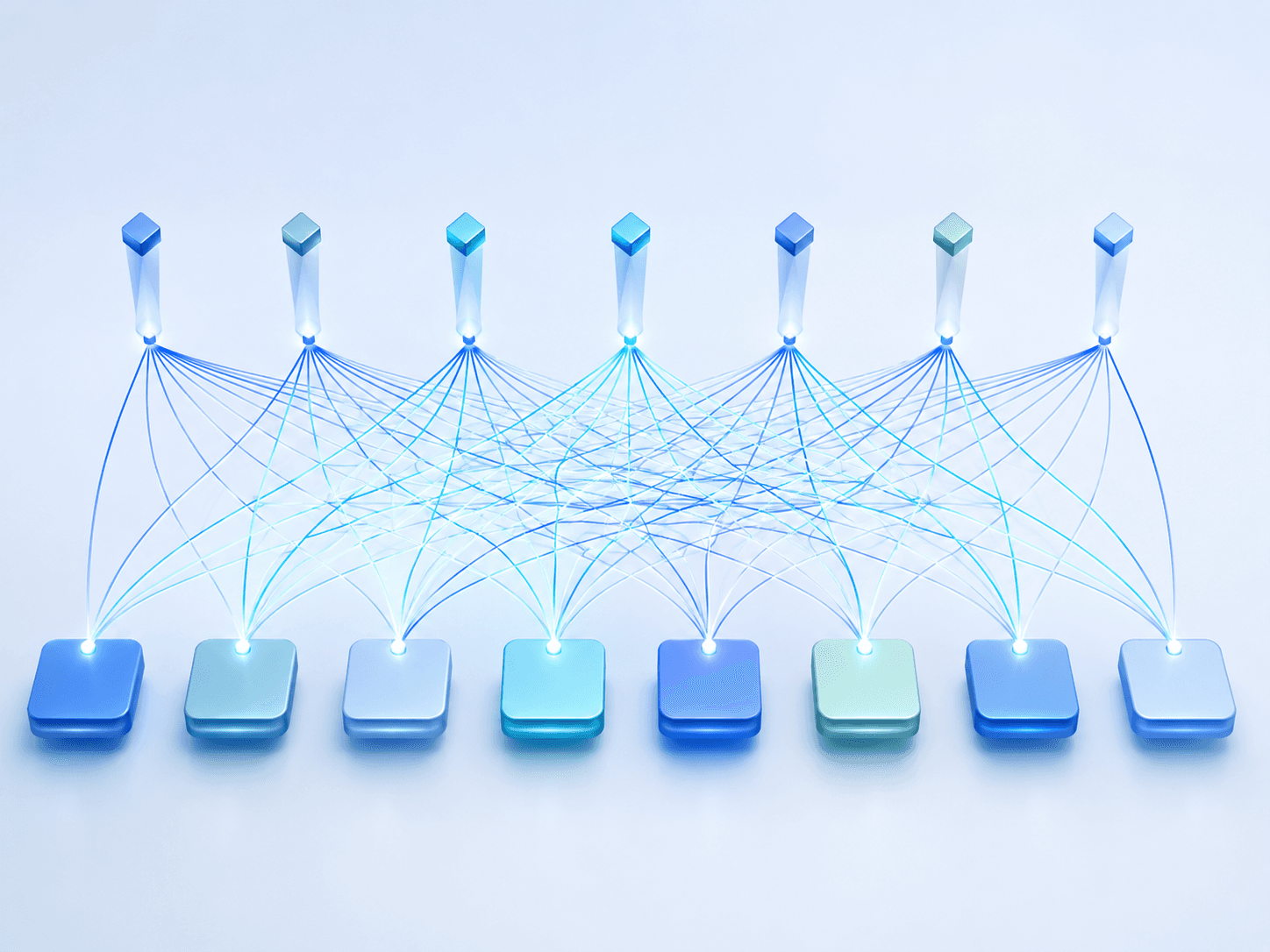
The heart of a Transformer is self-attention. Each token in the input is turned into three vectors — a query, a key and a value. To decide how much one token should pay attention to another, the model compares that token's query with every other token's key; the resulting scores become weights that blend all the value vectors together. Doing this for every token, in parallel, lets the model build a representation where each word already "knows" about the words that matter to it. Transformers stack many such attention layers, use several attention heads at once to capture different relationships, and add positional encodings so the model still knows word order despite processing everything at the same time.
Why Transformers took over AI
The Transformer won because it scales. A few properties explain why it replaced almost everything that came before:
- Parallelism: unlike RNNs, a Transformer processes all tokens at once, so it trains efficiently on modern GPUs and TPUs.
- Long-range context: self-attention links distant tokens directly, so a model can relate the start and end of a long document.
- Scaling laws: quality keeps improving predictably as you add data and parameters — the basis of GPT, Claude and Gemini.
- Generality: the same architecture handles text, images, audio and video, which is why it underpins today's multimodal models.
Transformers for images and video
Transformers are not just for text. The 2020 Vision Transformer (ViT) showed that an image can be split into small patches, treated like a sequence of "words", and fed to a Transformer for recognition. Generative image and video models followed: modern systems such as Stable Diffusion 3 and FLUX use a diffusion transformer (DiT) as their denoising backbone, and video models like Sora and Veo are built on the same idea. So a Transformer and a /glossary/diffusion model are not rivals — in 2026's best generators the diffusion process is run by a Transformer. Personalisation techniques like /glossary/lora then adapt those Transformer layers to a specific face or style.
How Twin AI uses Transformers
Every model you touch in Twin AI is a Transformer under the hood. The /chat surface runs Transformer-based large language models — GPT, Claude and Gemini — so you can compare their answers in one window, for example in /compare/chatgpt-vs-claude. The image side uses Transformer-driven diffusion models like /alternatives/flux-2-pro to power /use-cases/image-generator and your personal /use-cases/ai-photoshoot. You never configure attention heads or layers — you type a prompt or pick a template, and Twin handles the model. Everything is payable with a Russian card or SBP, with no VPN required. Start free in /chat or /create/photo.
FAQ
What is a Transformer in AI?
A Transformer is a neural-network architecture that processes a whole sequence at once using self-attention, letting every element weigh its relationship to every other. Introduced by Google in 2017, it is the architecture behind large language models like ChatGPT and Claude and behind modern image and video generators.
What is self-attention?
Self-attention is the core mechanism of a Transformer. Each token produces a query, key and value; the model compares queries with keys to score how relevant every other token is, then blends their values by those scores. This lets each token gather information from the whole sequence in a single parallel step.
Are GPT and Claude Transformers?
Yes. GPT, Claude, Gemini and virtually all modern large language models are Transformers — specifically decoder-only Transformers trained to predict the next token. You can chat with several of them in Twin AI and compare their answers side by side.
What is the difference between a Transformer and a diffusion model?
A Transformer is an architecture — a way of wiring a network with attention. A diffusion model is a training method for generating images by denoising. They are not opposites: modern image and video generators such as Stable Diffusion 3, FLUX, Sora and Veo run the diffusion process using a Transformer backbone (a diffusion transformer, or DiT).
Do I need to understand Transformers to use Twin AI?
No. Transformers run under the hood of every chat and image model in Twin AI. You just type a prompt or pick a template and Twin handles the architecture, model and settings for you. Try it free in /chat or /create/photo.