
Prompt (AI) — Definition, How It Works & How to Write One
Updated 1 August 2026 · Twin AI Labs
A prompt is the text instruction you give a generative AI model to tell it what to produce — an image, a video, a chat answer or code. It is the single most important control you have: the model reads your words, turns them into numbers, and generates an output shaped by exactly what you described. A clear, specific prompt is the difference between a generic result and a great one.

What is a prompt in AI?
A prompt is the input — usually plain text — that you feed a generative AI model to steer its output. In a chatbot like ChatGPT or Claude the prompt is your question or instruction; in an image generator like Midjourney or FLUX it is the description of the picture you want. The model does not understand words the way a person does: it converts your prompt into tokens, then into vectors, and uses them to condition its generation so the result matches your intent. Because the prompt is the only thing you fully control, learning to write good prompts — sometimes called "prompt engineering" — is the fastest way to better results.
How a prompt works under the hood
When you submit a prompt, the model first tokenises it — splitting the text into small chunks — and maps each token to a numeric embedding. In a /glossary/transformer-based language model those embeddings flow through attention layers that predict the next token, one at a time, building the answer. In a /glossary/diffusion image model the prompt embedding conditions the denoising process, pulling the picture toward your description at every step. A negative prompt does the opposite: it tells the model what to avoid. The clearer and more specific your tokens, the more precisely the model can aim.
How to write a good prompt
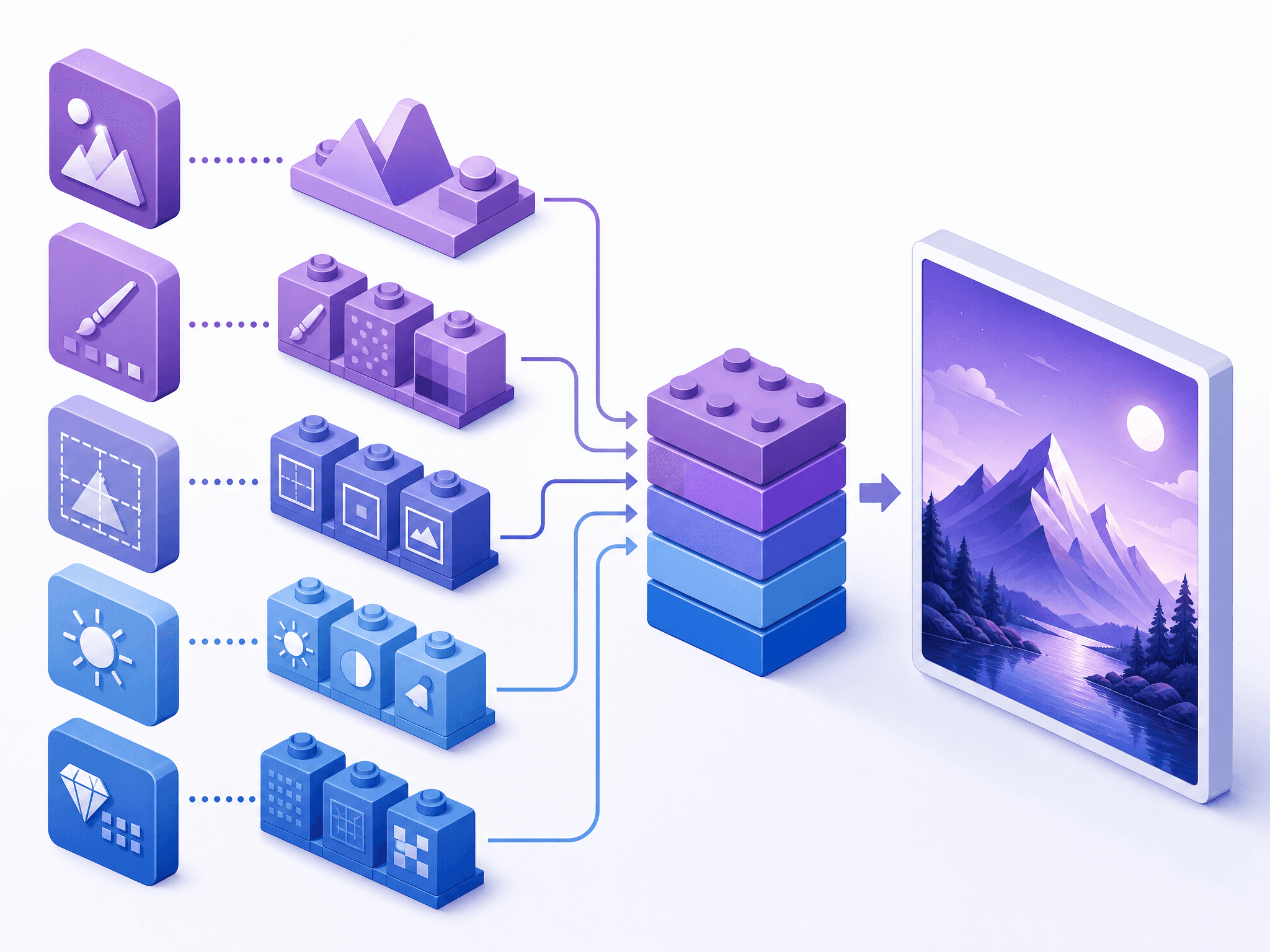
Strong prompts are specific, structured and iterative. A few practical rules apply across almost every model:
- Be specific: name the subject, style, composition, lighting and mood instead of a vague phrase — "a golden-hour portrait of a woman in a red coat, shallow depth of field" beats "a nice photo".
- State the format: for chat, ask for a list, table or word count; for images, mention aspect ratio, medium and camera details.
- Give context and role: "You are a senior copywriter…" or reference material makes a language model answer more precisely.
- Use a negative prompt on image models to exclude what you do not want — extra fingers, text, watermarks, blur.
- Iterate: change one variable at a time, keep the /glossary/lora or model fixed, and refine rather than rewriting from scratch.
Prompts for images vs prompts for chat
Image prompts and chat prompts reward different styles. Image models respond to dense, comma-separated descriptors — subject, style, lens, lighting — and to a separate negative prompt, and they are sensitive to word order and to a guidance value (CFG) that controls how literally they follow you. Chat models such as GPT, Claude and Gemini prefer natural, well-structured language with clear instructions, examples and a stated role; you can compare how each reads the same prompt in /compare/chatgpt-vs-claude. The same idea — describe intent precisely — drives both, but the phrasing differs.
How Twin AI helps with prompts
Twin AI is built so a good prompt is enough — you do not need to master any model's syntax. In /create/photo and /use-cases/image-generator you type a description and Twin routes it to the right engine, and its templates in /photoshoots are pre-written prompts you can start from and tweak. Because Twin runs several models side by side, you can send one prompt to more than one and compare, for example in /compare/midjourney-vs-flux, and its /chat surface lets you refine a prompt conversationally with GPT, Claude or Gemini. Everything is payable with a Russian card or SBP, with no VPN required. Start free in /create/photo.
FAQ
What is a prompt in simple terms?
A prompt is the text instruction you give an AI to tell it what to make — a question for a chatbot or a description of an image for a generator. The model reads your words and produces an output shaped by them, so a clear, specific prompt gives a better result.
What is prompt engineering?
Prompt engineering is the practice of writing and refining prompts to get better, more reliable outputs from an AI model. It includes being specific, giving context and examples, stating the desired format, using negative prompts on image models, and iterating one change at a time.
What is a negative prompt?
A negative prompt is a separate instruction used by image models that lists what you do not want in the result — such as extra fingers, text, watermarks or blur. The model steers away from those concepts while still following your main prompt.
Why do the same prompt give different results?
Generative models include randomness, controlled by a seed, so the same prompt can produce different images or answers each run. Fixing the seed and keeping the model and settings constant makes results repeatable, which is useful when you want to iterate on one variable at a time.
Do I need to learn prompting to use Twin AI?
No. Twin AI provides ready-made prompt templates in its photoshoots and picks the right model for you, so a plain description is enough. As you get comfortable you can write your own prompts and compare them across models. Try it free in /create/photo.