
DALL·E — Definition, How It Works & Versions
DALL·E is OpenAI's family of text-to-image models that turn a written /glossary/prompt into an original picture. First shown in January 2021, it now runs inside ChatGPT: you describe an image in words and the system generates it. The name is a play on the robot WALL-E and the painter Salvador Dalí, and each version — DALL·E 1, 2 and 3 — used a different technical approach under the hood.
What is DALL·E?
DALL·E is a text-to-image system built by OpenAI, the lab behind ChatGPT. You give it a /glossary/prompt — a sentence describing what you want to see — and it produces a new image that matches, rather than searching for an existing one. It is closed and hosted: the weights are private, you cannot self-host it the way you can /glossary/stable-diffusion, and you reach it only through OpenAI's products and API. Since DALL·E 3, the model is wired directly into ChatGPT, so generating a picture is just part of a normal conversation. Its strengths are faithful prompt-following and, unusually for image models, fairly reliable text inside the picture.
How DALL·E works
The technology behind the name changed dramatically across versions, which is why old explanations often no longer apply.
Each generation solved the text-to-image problem differently:
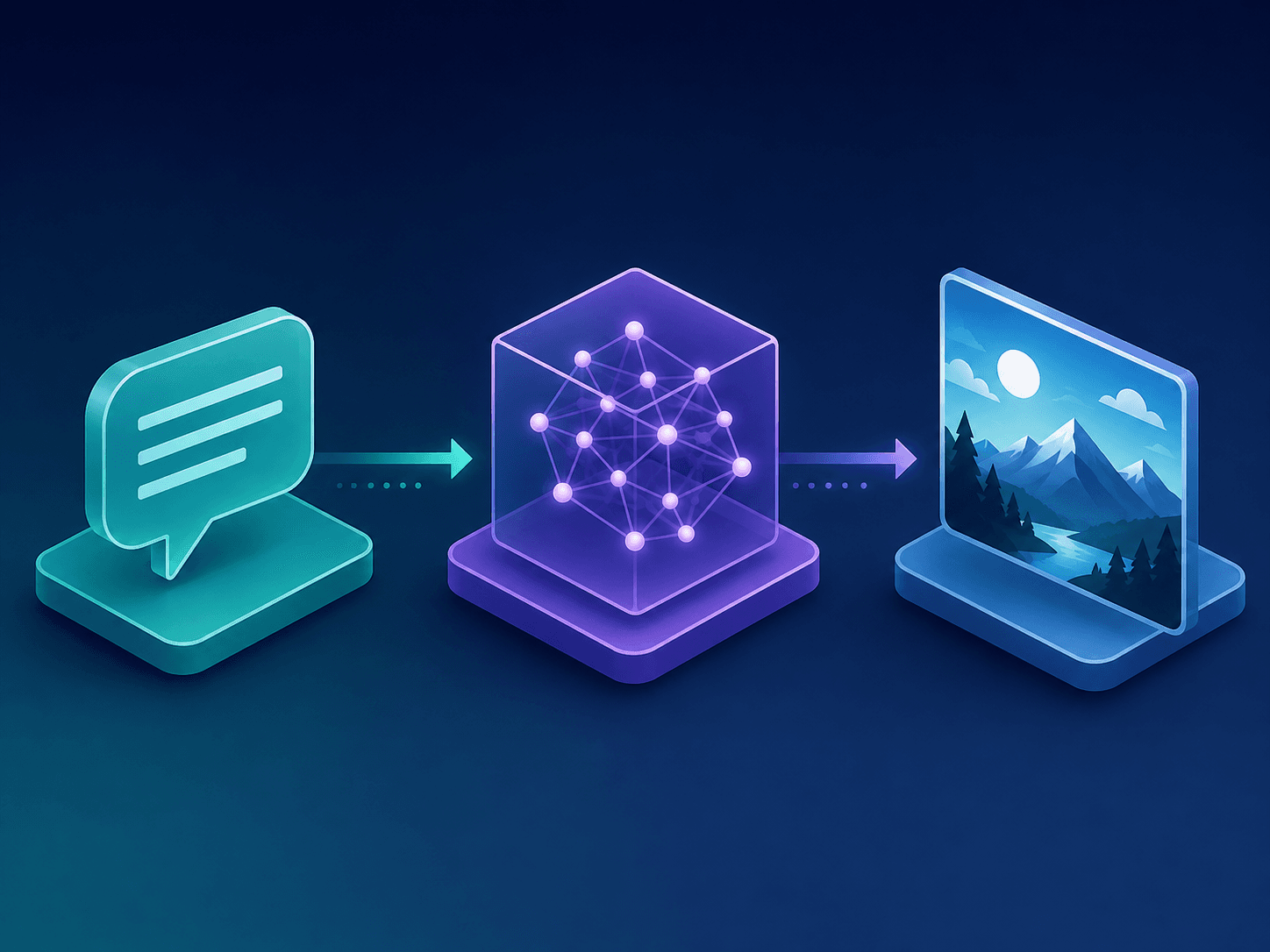
- DALL·E 1 (2021) — a /glossary/transformer that generated the image one token at a time, like a language model predicting pixels-as-words.
- DALL·E 2 (2022) — the "unCLIP" approach: it mapped the prompt into a CLIP image embedding, then used a /glossary/diffusion decoder to paint that embedding into pixels.
- DALL·E 3 (2023) — a diffusion model trained on richer captions, paired with ChatGPT, which quietly rewrites and expands your short prompt into a detailed one before generation.
DALL·E versions
Knowing the version tells you what quality and behaviour to expect, and OpenAI has since folded native image generation into its main GPT models:
- DALL·E 1 (January 2021) — a research demo; small, blocky, often surreal 256×256 images. Never a public product.
- DALL·E 2 (April 2022) — the first widely used version: sharper, higher-resolution, with inpainting and outpainting, but weak at text and fine prompt detail.
- DALL·E 3 (October 2023) — a big jump in prompt adherence and legible in-image text, delivered through ChatGPT, Microsoft Copilot and the API.
- GPT Image (2025) — OpenAI's newer native image model in GPT-4o that supersedes DALL·E for most in-app generation; DALL·E 3 remains available via the images API.
How to access and price DALL·E
There is no standalone DALL·E app. You use it through ChatGPT (a limited amount on the free tier, more on ChatGPT Plus at about $20/month), through Microsoft Copilot and Designer where it has been offered free, or through OpenAI's image API, which is billed per generated image. That means casual use is possible for free but capped, and heavier or programmatic use requires a paid OpenAI account. For users outside the US the practical barrier is often payment: OpenAI does not accept Russian cards, so a subscription or API top-up usually needs a foreign card or a VPN-plus-workaround.
How Twin AI relates to DALL·E
DALL·E is excellent at following instructions, but it locks you into one vendor, one account and — for many users — a payment wall. Twin AI takes the opposite path: it runs several leading image models — GPT Image, FLUX, Nano Banana and the /glossary/stable-diffusion family — behind one interface and auto-tunes the /glossary/sampler, steps and /glossary/cfg for each, so you get DALL·E-grade prompt-following without picking settings. Upload a few photos and Twin keeps your face consistent across a whole shoot, powering /use-cases/ai-photoshoot and /use-cases/image-generator, and you can run one prompt across models side by side. Everything is payable with a Russian card or SBP, no VPN required. Start free in /create/photo.
FAQ
What is DALL·E?
DALL·E is OpenAI's family of text-to-image AI models. You type a prompt describing an image and it generates an original picture that matches. First shown in 2021, it is now built into ChatGPT and is known for strong prompt-following and fairly reliable text inside the image.
Is DALL·E free?
Partly. You can generate a limited number of images free through ChatGPT and through Microsoft Copilot, but heavier use needs ChatGPT Plus (about $20/month) or OpenAI's paid image API. Twin AI, by contrast, lets you start generating high-quality AI images for free without a foreign card.
How is DALL·E different from Midjourney?
DALL·E is built into ChatGPT and prioritises literal prompt-following and legible in-image text, while /glossary/midjourney is a subscription service known for a highly polished default aesthetic. DALL·E is easier to instruct precisely; Midjourney tends to look more artistic out of the box.
What model does DALL·E use?
It has changed. DALL·E 1 used an autoregressive transformer, DALL·E 2 used CLIP embeddings with a diffusion decoder, and DALL·E 3 is a diffusion model paired with ChatGPT for prompt rewriting. In 2025 OpenAI moved native in-app generation to its newer GPT Image model.
Do I need DALL·E to use Twin AI?
No. Twin AI runs several modern image models for you behind one interface and auto-tunes their settings, so you get comparable prompt-following without an OpenAI subscription or a foreign card. Just upload photos in /create/photo.